Engineering
Overview
Engineering calculations form the computational backbone of design, analysis, and optimization across mechanical, chemical, civil, electrical, and environmental disciplines. From fluid mechanics and thermodynamics to photovoltaics and process control, these tools leverage specialized Python libraries to solve problems that demand precision, industry-standard correlations, and validated property databases.
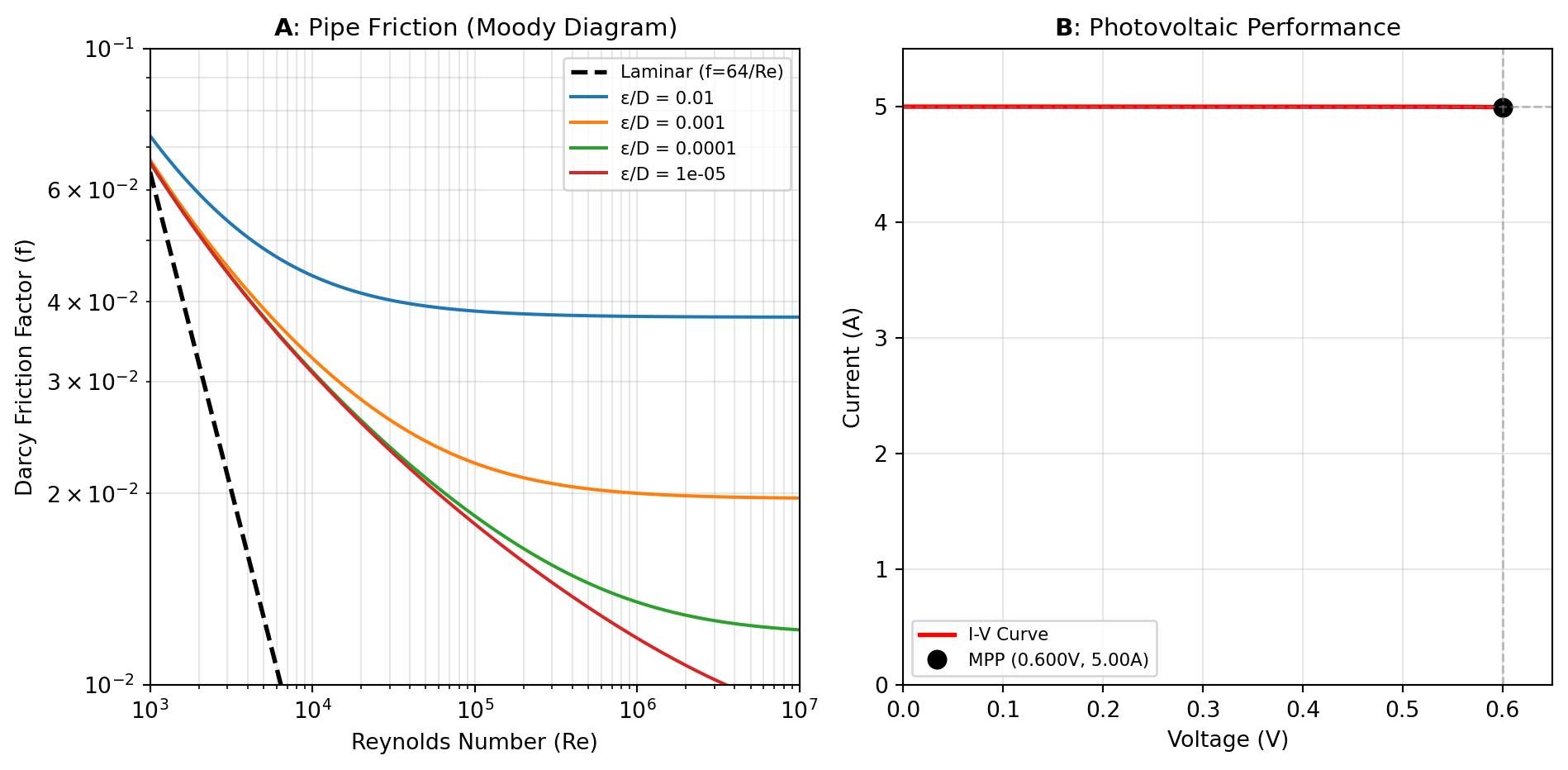
Fluid Mechanics encompasses the largest collection of engineering tools, addressing pipe flow, compressible flow, control valves, and two-phase systems. The fluids library provides battle-tested implementations of industry correlations like the Colebrook equation for friction factors, the Panhandle equations for natural gas pipelines, and IEC 60534 standards for control valve sizing. Whether calculating Reynolds numbers for regime classification, sizing orifice plates for flow measurement, or determining pressure drops through fittings, these tools handle both laminar and turbulent regimes with appropriate methods automatically selected based on dimensionless parameters.
For friction factor calculations, use FRICTION_FACTOR as the primary entry point—it automatically selects the optimal correlation (Clamond, Colebrook, Churchill, or Haaland) based on Reynolds number and relative roughness. Specialized correlations like BLASIUS (smooth turbulent flow) or MOODY are available when specific methods are required. Compressible flow tools handle gas transmission through pipelines with methods ranging from theoretical ISOTHERMAL_GAS to empirical formulas like WEYMOUTH_FLOW and PANHANDLE_B. Stagnation properties, critical flow conditions, and polytropic efficiency conversions are all available.
Control valve calculations follow IEC 60534 standards for both liquid and gas service, including flow coefficient conversions (Cv, Kv, Av), characteristic curves (linear, equal percentage, quick opening), cavitation and choked flow detection, and noise prediction per IEC 60534-8-3 (gas) and IEC 60534-8-4 (liquid). Use SIZE_CV_LIQUID and SIZE_CV_GAS for valve sizing, and IS_CHOKED_LIQ or IS_CHOKED_GAS to detect critical flow conditions.
Dimensionless numbers characterize flow regimes and similarity: Reynolds number, Froude number for open channel flow, Bond number for surface tension effects, and specialized parameters like Dean number for curved pipes. Drag calculations provide 20+ correlations for sphere drag coefficients optimized for different Reynolds number ranges, from Stokes flow (Re < 1) to high-Re turbulent regimes. The general DRAG_SPHERE function selects appropriate correlations automatically, while terminal velocity and settling calculations support particle separation design.
Flow meters implement differential pressure calculations per ISO 5167 for orifice plates, venturi tubes, and flow nozzles. Tools calculate discharge coefficients, expansibility factors, and non-recoverable pressure drops. Fittings and valves provide loss coefficients (K-factors) for bends, contractions, expansions, and various entrance/exit conditions based on Crane TP-410 and Idelchik correlations. Atmospheric calculations include the US Standard Atmosphere 1976 model and the NRLMSISE-00 model for temperature, pressure, and density at altitude.
Photovoltaic calculations leverage the pvlib-python library for solar energy system design and analysis. Calculate solar position (azimuth, elevation, zenith) for any location and time, determine irradiance components on tilted surfaces accounting for beam, diffuse, and ground-reflected radiation, and model PV module performance using the single-diode equation via I_FROM_V or simplified PVWatts DC models. The CEC model parameters adjust cell performance for temperature and irradiance variations, critical for accurate energy yield predictions.
These engineering tools bridge the gap between spreadsheet accessibility and programmatic power, providing validated implementations of industry standards that would be error-prone to implement manually.
Chemical
Chemical Properties
| Tool | Description |
|---|---|
| CAS_FROM_ANY | Resolve a chemical identifier to its standardized CAS number. |
| CHEMICAL_PROPS | Retrieve physical and thermodynamic properties for a chemical specimen. |
| DIPOLE | Retrieve the dipole moment of a chemical by CAS number. |
| OMEGA | Retrieve the acentric factor of a chemical by CAS number. |
| PC | Retrieve the critical pressure of a chemical by CAS number. |
| SEARCH_CHEMICAL | Resolve a chemical identifier and return a compact metadata summary. |
| TB | Retrieve the normal boiling temperature of a chemical by CAS number. |
| TC | Retrieve the critical temperature of a chemical by CAS number. |
| TM | Retrieve the melting temperature of a chemical by CAS number. |
| VC | Retrieve the critical molar volume of a chemical by CAS number. |
Combustion Fuels
| Tool | Description |
|---|---|
| AIR_FUEL_RATIO | Calculates molar flow rate of air or fuel from the other, using a specified air-fuel ratio. |
| COMBUSTION_STOICH | Returns a dictionary of stoichiometric coefficients of chemical combustion from an atoms dictionary. |
| FUEL_AIR_SPEC | Solves the system of equations describing a flow of air mixing with a flow of combustibles and burning completely. |
| HHV_STOICHIOMETRY | Returns the higher heating value based on theoretical combustion stoichiometry and heat of formation. |
| IS_COMBUSTIBLE | Checks if a chemical is combustible based on its CAS and atoms. |
| LHV_FROM_HHV | Returns the lower heating value (LHV) of a chemical given the higher heating value (HHV) and number of water molecules formed. |
| MON | This function handles the retrieval of a chemical’s motor octane number (MON), using CASRN. |
| RON | This function handles the retrieval of a chemical’s research octane number (RON), using CASRN. |
Process Safety
| Tool | Description |
|---|---|
| CARCINOGEN_STATUS | Looks up if a chemical is listed as a carcinogen according to specific methods. |
| CEILING_LIMIT | Handles the retrieval of ceiling limits on worker exposure to dangerous chemicals. |
| LFL | Handles the retrieval or calculation of a chemical’s Lower Flammability Limit. |
| STEL | Handles the retrieval of Short-term Exposure Limit (STEL) for worker exposure. |
| T_AUTOIGNITION | Handles the retrieval or calculation of a chemical’s autoignition temperature. |
| T_FLASH | Handles the retrieval or calculation of a chemical’s flash point. |
| TWA_LIMIT | Return the Time-Weighted Average exposure limits (TWA) for the desired chemical. |
| UFL | Handles the retrieval or calculation of a chemical’s Upper Flammability Limit. |
Control Systems
Analysis
| Tool | Description |
|---|---|
| DAMP | Compute the system’s natural frequencies, damping ratios, and poles. |
| FORCED_RESPONSE | Compute the output of a linear system given an arbitrary input signal. |
| IMPULSE_RESPONSE | Compute the impulse response for a linear system. |
| INITIAL_RESPONSE | Compute the initial condition response for a state-space system. |
| MARGIN | Calculate the gain and phase margins and crossover frequencies of a system. |
| POLES | Compute the poles of a linear system. |
| PZMAP | Compute the poles and zeros of a linear system. |
| ZEROS | Compute the zeros of a linear system. |
Design
| Tool | Description |
|---|---|
| ACKER | Pole placement using Ackermann’s formula. |
| DLQE | Linear quadratic estimator (Kalman filter) for discrete-time systems. |
| DLQR | Linear quadratic regulator design for discrete-time systems. |
| LQE | Linear quadratic estimator (Kalman filter) for continuous-time systems. |
| LQR | Linear quadratic regulator design for continuous-time systems. |
| MIXSYN | Mixed-sensitivity H-infinity controller synthesis. |
| PLACE | Pole placement for state feedback gain design. |
| ROOT_LOCUS | Calculate the root locus for an LTI system. |
Fuzzy
| Tool | Description |
|---|---|
| DEFUZZ | Defuzzify a membership function to return a crisp value. |
| FUZZY_AND | Calculate the fuzzy AND operator (intersection) of two fuzzy sets. |
| FUZZY_NOT | Calculate the fuzzy NOT operator (complement) of a fuzzy set. |
| FUZZY_OR | Calculate the fuzzy OR operator (union) of two fuzzy sets. |
| GAUSS2MF | Generate a Gaussian fuzzy membership function of two combined Gaussians. |
| GAUSSMF | Generate a Gaussian fuzzy membership function. |
| GBELLMF | Generate a Generalized Bell fuzzy membership function. |
| PIECEMF | Generate a piecewise linear fuzzy membership function. |
| PIMF | Generate a Pi-function fuzzy membership generator. |
| PSIGMF | Generate the product of two sigmoid membership functions. |
| SIGMF | Generate a basic sigmoid membership function. |
| SMF | Generate an S-function fuzzy membership generator. |
| TRAPMF | Generate a trapezoidal fuzzy membership function. |
| TRIMF | Generate a triangular fuzzy membership function. |
| ZMF | Generate a Z-function fuzzy membership generator. |
Interconnection
| Tool | Description |
|---|---|
| FEEDBACK | Feedback interconnection of two LTI systems. |
| PARALLEL | Parallel interconnection of two LTI systems. |
| SERIES | Series interconnection of two LTI systems. |
Matrix Computations
| Tool | Description |
|---|---|
| CARE | Solve the continuous-time algebraic Riccati equation. |
| CTRB | Compute the controllability matrix. |
| DARE | Solve the discrete-time algebraic Riccati equation. |
| DLYAP | Solve the discrete-time Lyapunov equation. |
| GRAM | Compute the Gramian (controllability or observability). |
| LYAP | Solve the continuous-time Lyapunov equation. |
| OBSV | Compute the observability matrix. |
Modeling
| Tool | Description |
|---|---|
| C2D | Convert a continuous-time system to discrete-time by sampling. |
| FRD | Create a frequency response data (FRD) model from measured response data. |
| PADE_DELAY | Calculate the Pade approximation of a continuous time delay. |
| SS2TF | Transform a state-space system into a transfer function. |
| STATE_SPACE | Create a state-space system model from system, control, output, and feedforward matrices. |
| TF2SS | Convert a transfer function object back into a state-space system object. |
| TRANSFER_FUNCTION | Create a transfer function system from its numerator and denominator polynomial coefficients. |
| ZPK | Create a transfer function model from zeros, poles, and gain. |
Reduction
| Tool | Description |
|---|---|
| BALRED | Balanced reduced order model of a system. |
| MINREAL | Eliminate uncontrollable or unobservable states. |
Fluids
Atmosphere
| Tool | Description |
|---|---|
| AIRMASS | Calculate the mass of air per square meter in the atmosphere along a given angle using a density profile. |
| ATMOS_NRLMSISE00 | Compute temperature, density, and pressure using the NRLMSISE-00 atmospheric model. |
| ATMOSPHERE_1976 | Calculate standard atmospheric properties at a given altitude using the US Standard Atmosphere 1976 model. |
Compressible
| Tool | Description |
|---|---|
| FRITZSCHE_FLOW | Calculate gas flow rate using the Fritzsche formula. |
| IGT_FLOW | Calculate gas flow rate using the IGT (Institute of Gas Technology) formula. |
| IS_CHOKED_FLOW | Determine if a flow is choked (critical) based on pressure ratio. |
| ISENTROPIC_EFF | Convert between isentropic and polytropic efficiency for compression. |
| ISENTROPIC_T_RISE | Calculate the temperature rise for isentropic compression or expansion. |
| ISENTROPIC_WORK | Calculate work of compression or expansion for a gas in an isentropic process. |
| ISOTHERMAL_GAS | Calculate mass flow rate for isothermal compressible gas flow in a pipe. |
| ISOTHERMAL_WORK | Calculate work of compression or expansion for a gas in an isothermal process. |
| MULLER_FLOW | Calculate gas flow rate using the Muller formula. |
| P_CRITICAL_FLOW | Calculate critical flow pressure for a fluid at Mach 1. |
| P_STAGNATION | Calculate stagnation pressure from static conditions. |
| PANHANDLE_A | Calculate gas flow rate in a pipeline using the Panhandle A formula. |
| PANHANDLE_B | Calculate gas flow rate in a pipeline using the Panhandle B formula. |
| POLYTROPIC_EXP | Calculate polytropic exponent or polytropic efficiency for compression. |
| STAGNATION_ENERGY | Calculate the increase in enthalpy due to fluid velocity. |
| T_CRITICAL_FLOW | Calculate critical flow temperature for a fluid at Mach 1. |
| T_STAG_IDEAL | Calculate ideal stagnation temperature from velocity and heat capacity. |
| T_STAGNATION | Calculate stagnation temperature from pressure ratio. |
| WEYMOUTH_FLOW | Calculate gas flow rate in a pipeline using the Weymouth formula. |
Control Valve
| Tool | Description |
|---|---|
| CV_CAV_INDEX | Calculates the cavitation index of a control valve. |
| CV_CHAR_EQ_PERC | Calculates the flow coefficient characteristic for an equal percentage control valve. |
| CV_CHAR_LINEAR | Calculates the flow coefficient characteristic for a linear control valve. |
| CV_CHAR_QUICK_OP | Calculates the flow coefficient characteristic for a quick opening control valve. |
| CV_CHOKE_PRESS_GAS | Calculates the pressure at which choked flow occurs in a gas control valve. |
| CV_CHOKE_PRESS_LIQ | Calculates the pressure at which choked flow occurs in a liquid control valve. |
| CV_CONVERT_COEFF | Converts between different flow coefficient scales (Kv, Cv, Av). |
| CV_NOISE_GAS_2011 | Calculate the A-weighted sound pressure level for gas flow through a control valve per IEC 60534-8-3 (2011). |
| CV_NOISE_LIQ_2015 | Calculates the sound made by a liquid flowing through a control valve according to the standard IEC 60534-8-4 (2015) using fluids.control_valve.control_valve_noise_l_2015. |
| FF_CRIT_PRESS_L | Calculates the liquid critical pressure ratio factor FF for IEC 60534 liquid valve sizing. |
| IS_CHOKED_GAS | Determines if a gas flow in a control valve is choked (critical) or not according to IEC 60534. |
| IS_CHOKED_LIQ | Determines if a liquid flow in a control valve is choked (critical) or not according to IEC 60534. |
| LOSS_COEFF_PIPING | Calculates the sum of loss coefficients for reducers/expanders around a control valve. |
| REYNOLDS_FACTOR | Calculates the Reynolds number factor FR for a valve according to IEC 60534. |
| REYNOLDS_VALVE | Calculates the Reynolds number of a control valve according to IEC 60534. |
| SIZE_CV_GAS | Calculates flow coefficient of a control valve passing a gas according to IEC 60534 using fluids.control_valve.size_control_valve_g. |
| SIZE_CV_LIQUID | Calculates the flow coefficient (Kv) of a control valve passing a liquid according to IEC 60534. |
Dimensionless
| Tool | Description |
|---|---|
| ARCHIMEDES | Calculate the Archimedes number (Ar) for a fluid and particle. |
| BEJAN | Compute the Bejan number (length-based or permeability-based). |
| BIOT | Calculate the Biot number for heat transfer. |
| BOILING | Calculate the Boiling number (Bg), a dimensionless number for boiling heat transfer. |
| BOND | Calculate the Bond number (Bo), also known as the Eötvös number (Eo). |
| CAPILLARY | Calculate the Capillary number (Ca) for a fluid system using fluids.core.Capillary. |
| CAVITATION | Calculate the Cavitation number (Ca) for a flowing fluid. |
| CONFINEMENT | Calculate the Confinement number (Co) for two-phase flow in a channel. |
| DEAN | Calculate the Dean number (De) for flow in a curved pipe or channel. |
| DRAG | Calculate the drag coefficient (dimensionless) for an object in a fluid. |
| ECKERT | Calculate the Eckert number using fluids.core.Eckert. |
| EULER | Calculate the Euler number (Eu) for a fluid flow. |
| FOURIER_HEAT | Calculate the Fourier number for heat transfer. |
| FOURIER_MASS | Calculate the Fourier number for mass transfer (Fo). |
| FROUDE | Calculate the Froude number (Fr) for a given velocity, length, and gravity. |
| FROUDE_DENSIMETRIC | Calculate the densimetric Froude number. |
| GRAETZ_HEAT | Calculate the Graetz number. |
| GRASHOF | Calculate the Grashof number. |
| HAGEN | Calculate the Hagen number. |
| JAKOB | Calculate the Jakob number for boiling fluid. |
| KNUDSEN | Calculate the Knudsen number. |
| LEWIS | Calculate the Lewis number. |
| MACH | Calculate the Mach number. |
| MORTON | Calculate the Morton number. |
| NUSSELT | Calculate the Nusselt number. |
| OHNESORGE | Calculate the Ohnesorge number. |
| PECLET_HEAT | Calculate the Peclet number for heat transfer. |
| PECLET_MASS | Calculate the Peclet number for mass transfer. |
| POWER_NUMBER | Calculate the Power number for an agitator. |
| PRANDTL | Calculate the Prandtl number. |
| RAYLEIGH | Calculate the Rayleigh number. |
| RELATIVE_ROUGHNESS | Calculate the relative roughness. |
| REYNOLDS | Calculate the Reynolds number. |
| SCHMIDT | Calculate the Schmidt number. |
| SHERWOOD | Calculate the Sherwood number. |
| STANTON | Calculate the Stanton number. |
| STOKES_NUMBER | Calculate the Stokes number. |
| STROUHAL | Calculate the Strouhal number. |
| SURATMAN | Calculate the Suratman number. |
| WEBER | Calculate the Weber number. |
Drag
| Tool | Description |
|---|---|
| CD_ALMEDEIJ | Calculate drag coefficient of a sphere using the Almedeij correlation. |
| CD_BARATI | Calculate drag coefficient of a sphere using the Barati correlation. |
| CD_BARATI_HIGH | Calculate drag coefficient of a sphere using the Barati high-Re correlation (valid to Re=1E6). |
| CD_CEYLAN | Calculate drag coefficient of a sphere using the Ceylan correlation. |
| CD_CHENG | Calculate drag coefficient of a sphere using the Cheng correlation. |
| CD_CLIFT | Calculate drag coefficient of a sphere using the Clift correlation. |
| CD_CLIFT_GAUVIN | Calculate drag coefficient of a sphere using the Clift-Gauvin correlation. |
| CD_ENGELUND | Calculate drag coefficient of a sphere using the Engelund-Hansen correlation. |
| CD_FLEMMER_BANKS | Calculate drag coefficient of a sphere using the Flemmer-Banks correlation. |
| CD_GRAF | Calculate drag coefficient of a sphere using the Graf correlation. |
| CD_HAIDER_LEV | Calculate drag coefficient of a sphere using the Haider-Levenspiel correlation. |
| CD_KHAN_RICH | Calculate drag coefficient of a sphere using the Khan-Richardson correlation. |
| CD_MIKHAILOV | Calculate drag coefficient of a sphere using the Mikhailov-Freire correlation. |
| CD_MORRISON | Calculate drag coefficient of a sphere using the Morrison correlation. |
| CD_MORSI_ALEX | Calculate drag coefficient of a sphere using the Morsi-Alexander correlation. |
| CD_ROUSE | Calculate drag coefficient of a sphere using the Rouse correlation. |
| CD_SONG_XU | Calculate drag coefficient of a particle using the Song-Xu correlation for spherical and non-spherical particles. |
| CD_STOKES | Calculate drag coefficient of a sphere using Stokes law (Cd = 24/Re). |
| CD_SWAMEE_OJHA | Calculate drag coefficient of a sphere using the Swamee-Ojha correlation. |
| CD_TERFOUS | Calculate drag coefficient of a sphere using the Terfous correlation. |
| CD_YEN | Calculate drag coefficient of a sphere using the Yen correlation. |
| DRAG_SPHERE | Calculate the drag coefficient of a sphere using various correlations based on Reynolds number. |
| SPHERE_FALL_DIST | Calculate distance traveled by a falling sphere after a given time. |
| SPHERE_VEL_AT_T | Calculate the velocity of a falling sphere after a given time. |
| TIME_V_TERMINAL | Calculate time for a particle in Stokes regime to reach terminal velocity. |
| V_TERMINAL | Calculate terminal velocity of a falling sphere using drag coefficient correlations. |
Filters
| Tool | Description |
|---|---|
| RND_EDGE_GRILL | Calculate the loss coefficient for a rounded edge grill or perforated plate. |
| RND_EDGE_MESH | Calculate the loss coefficient for a round edged open net or screen mesh. |
| RND_EDGE_SCREEN | Calculate the loss coefficient for a round edged wire screen or bar screen. |
| SQ_EDGE_GRILL | Calculate the loss coefficient for a square edged grill or perforated plate. |
| SQ_EDGE_SCREEN | Calculate the loss coefficient for a square edged wire screen, bar screen, or perforated plate. |
Fittings
| Tool | Description |
|---|---|
| BEND_MITER | Calculate the loss coefficient (K) for a single-joint miter bend in a pipe. |
| BEND_ROUNDED | Calculate the loss coefficient (K) for a rounded pipe bend (elbow) using various methods. |
| CONTRACTION_ROUND | Calculate the loss coefficient (K) for a rounded pipe contraction (reducer). |
| CONTRACTION_SHARP | Calculate the loss coefficient (K) for a sharp edged pipe contraction (reducer). |
| CV_TO_K | Convert imperial valve flow coefficient (Cv) to loss coefficient (K). |
| DIFFUSER_CONICAL | Calculate the loss coefficient (K) for a conical pipe expansion (diffuser). |
| DIFFUSER_SHARP | Calculate the loss coefficient (K) for a sudden pipe expansion (diffuser). |
| ENTRANCE_ANGLED | Calculate the loss coefficient (K) for an angled sharp entrance to a pipe flush with a reservoir wall. |
| ENTRANCE_BEVELED | Calculate the loss coefficient (K) for a beveled or chamfered entrance to a pipe flush with a reservoir wall. |
| ENTRANCE_ROUNDED | Calculate the loss coefficient (K) for a rounded entrance to a pipe flush with a reservoir wall. |
| ENTRANCE_SHARP | Calculate the loss coefficient (K) for a sharp entrance to a pipe flush with a reservoir wall. |
| EXIT_NORMAL | Calculate the loss coefficient (K) for a normal pipe exit discharging into a reservoir. |
| HELIX | Calculate the loss coefficient (K) for a helical coil pipe section. |
| K_BALL_VALVE | Calculate the loss coefficient (K) for a ball valve using the Crane method. |
| K_BUTTERFLY_VALVE | Calculate the loss coefficient (K) for a butterfly valve using the Crane method. |
| K_GATE_VALVE | Calculate the loss coefficient (K) for a gate valve using the Crane method. |
| K_GLOBE_VALVE | Calculate the loss coefficient (K) for a globe valve using the Crane method. |
| K_SWING_CHECK_VALVE | Calculate the loss coefficient (K) for a swing check valve using the Crane method. |
| K_TO_CV | Convert loss coefficient (K) to imperial valve flow coefficient (Cv). |
| K_TO_KV | Convert loss coefficient (K) to metric valve flow coefficient (Kv). |
| KV_TO_K | Convert metric valve flow coefficient (Kv) to loss coefficient (K). |
| SPIRAL | Calculate the loss coefficient (K) for a spiral coil pipe section. |
Flow Meter
| Tool | Description |
|---|---|
| DIFF_PRESS_BETA | Calculate the beta ratio (diameter ratio) for a differential pressure flow meter. |
| DIFF_PRESS_C_EPS | Calculate discharge coefficient and expansibility factor for differential pressure flow meters. |
| DIFF_PRESS_DP | Calculate non-recoverable pressure drop across a differential pressure flow meter. |
| FLOW_METER_DISCH | Calculate mass flow rate through a differential pressure flow meter based on measured pressures and meter geometry. |
| ORIFICE_DISCHARGE_C | Calculate the discharge coefficient for an orifice plate using the Reader-Harris-Gallagher correlation (ISO 5167 standard). |
| ORIFICE_EXPAND | Calculate the expansibility factor for an orifice plate based on geometry and pressure conditions. |
| ORIFICE_PRESS_DROP | Calculate non-recoverable pressure drop across an orifice plate based on geometry and discharge coefficient. |
Friction
| Tool | Description |
|---|---|
| BLASIUS | Calculates Darcy friction factor for turbulent flow in smooth pipes using the Blasius correlation. |
| CHURCHILL | Calculate Darcy friction factor using the Churchill (1977) universal equation for all flow regimes. |
| CLAMOND | Calculate Darcy friction factor using Clamond’s high-precision solution accurate to nearly machine precision. |
| COLEBROOK | Calculate Darcy friction factor using exact solution to the Colebrook equation. |
| DP_GRAV | Calculate gravitational pressure drop component for single-phase flow in inclined pipes. |
| FF_CURVED | Calculate friction factor for fluid flowing in a curved pipe or helical coil, supporting both laminar and turbulent regimes. |
| FP_MARTIN | Calculate Darcy friction factor for single-phase flow in Chevron-style plate heat exchangers using Martin (1999) correlation. |
| FP_MULEY_MANGLIK | Calculate Darcy friction factor for single-phase flow in Chevron-style plate heat exchangers using Muley-Manglik correlation. |
| FRICTION_FACTOR | Calculate the Darcy friction factor for fluid flow in a pipe using various correlations, automatically selecting appropriate method based on Reynolds number and relative roughness. |
| FRICTION_LAMINAR | Calculate the Darcy friction factor for laminar flow using the theoretical solution fd = 64/Re. |
| FT_CRANE | Calculate the Crane fully turbulent Darcy friction factor for flow in commercial pipe. |
| HAALAND | Calculate Darcy friction factor using the Haaland (1983) approximation. |
| HELICAL_RE_CRIT | Calculate the transition Reynolds number for fluid flowing in a curved or helical pipe between laminar and turbulent flow. |
| MOODY | Calculate Darcy friction factor using the Moody (1947) correlation. |
| ONE_PHASE_DP | Calculate single-phase pressure drop in a pipe using the Darcy-Weisbach equation. |
| SWAMEE_JAIN | Calculate Darcy friction factor using the Swamee-Jain (1976) equation. |
| TRANS_FACTOR | Convert between Darcy friction factor and transmission factor for compressible gas pipeline flow. |
| VON_KARMAN | Calculate Darcy friction factor for rough pipes at infinite Reynolds number from the von Karman equation. |
Heat Transfer
Air Cooler
| Tool | Description |
|---|---|
| AIR_NOISE_GPSA | Compute air cooler noise using the GPSA correlation. |
| AIR_NOISE_MUKHERJEE | Compute air cooler noise using the Mukherjee correlation. |
| DP_ESDU_HIGH_FIN | Compute air-side pressure drop for high-fin tube banks. |
| DP_ESDU_LOW_FIN | Compute air-side pressure drop for low-fin tube banks. |
| ESDU_TUBE_ROW_CORR | Compute the ESDU tube row correction factor for a tube bundle. |
| FIN_EFF_KERN_KRAUS | Compute circular fin efficiency for constant-thickness fins. |
| FT_AIRCOOLER | Compute the LMTD correction factor for an air cooler crossflow exchanger. |
| H_BRIGGS_YOUNG | Compute air-side heat transfer coefficient using Briggs and Young correlations. |
| H_ESDU_HIGH_FIN | Compute air-side heat transfer coefficient for high-fin tube banks. |
| H_ESDU_LOW_FIN | Compute air-side heat transfer coefficient for low-fin tube banks. |
| H_GANGULI_VDI | Compute air-side heat transfer coefficient using the Ganguli VDI method. |
| LMTD | Compute the log-mean temperature difference for a heat exchanger. |
| WALL_FACTOR | Compute wall property correction factors for heat transfer correlations. |
Boiling Flow
| Tool | Description |
|---|---|
| CHEN_BENNETT | Compute the Chen-Bennett boiling heat transfer coefficient. |
| CHEN_EDELSTEIN | Compute the Chen-Edelstein boiling heat transfer coefficient. |
| COOPER | Compute the Cooper nucleate boiling heat transfer coefficient. |
| FORSTER_ZUBER | Compute the Forster-Zuber nucleate boiling heat transfer coefficient. |
| LAZAREK_BLACK | Compute the Lazarek-Black boiling heat transfer coefficient. |
| LI_WU | Compute the Li-Wu boiling heat transfer coefficient. |
| LIU_WINTERTON | Compute the Liu-Winterton boiling heat transfer coefficient. |
| LOCKHART_XTT | Compute the Lockhart-Martinelli Xtt two-phase flow parameter. |
| SUN_MISHIMA | Compute the Sun-Mishima boiling heat transfer coefficient. |
| THOME | Compute the Thome microchannel boiling heat transfer coefficient. |
| TO_SOLVE_Q_THOME | Compute the Thome heat flux residual for a specified wall temperature. |
| TURBULENT_DITTUS | Compute the Dittus-Boelter turbulent Nusselt number. |
| TURBULENT_GNIEL | Compute the Gnielinski turbulent Nusselt number. |
| YUN_HEO_KIM | Compute the Yun-Heo-Kim boiling heat transfer coefficient. |
Boiling Nucleic
| Tool | Description |
|---|---|
| BIER | Compute nucleate boiling heat transfer coefficient using the Bier correlation. |
| GORENFLO | Compute nucleate boiling heat transfer coefficient using the Gorenflo correlation. |
| H_NUCLEIC | Compute nucleate boiling heat transfer coefficient with method selection. |
| H_NUCLEIC_METHODS | List available nucleate boiling correlations based on provided inputs. |
| HEDH_MONTINSKY | Compute nucleate boiling critical heat flux using the HEDH-Montinsky correlation. |
| HEDH_TABOREK | Compute nucleate boiling heat transfer coefficient using the HEDH-Taborek correlation. |
| MCNELLY | Compute nucleate boiling heat transfer coefficient using the McNelly correlation. |
| MONTINSKY | Compute nucleate boiling heat transfer coefficient using the Montinsky correlation. |
| QMAX_BOIL_METHODS | List available nucleate boiling critical heat flux correlations. |
| QMAX_BOILING | Compute nucleate boiling critical heat flux with method selection. |
| ROHSENOW | Compute nucleate boiling heat transfer coefficient using the Rohsenow correlation. |
| SERTH_HEDH | Compute nucleate boiling critical heat flux for tube bundles using the Serth-HEDH correlation. |
| STEPHAN_ABDELSALAM | Compute nucleate boiling heat transfer coefficient using the Stephan-Abdelsalam correlation. |
| ZUBER | Compute nucleate boiling critical heat flux using the Zuber correlation. |
Boiling Plate
| Tool | Description |
|---|---|
| H_BOIL_HAN_LEE_KIM | Calculate boiling heat transfer coefficient using Han Lee Kim correlation. |
| H_BOIL_HANLEEKIM | Calculate boiling heat transfer coefficient using Han Lee Kim correlation. |
| H_BOIL_HUANG_SHEER | Calculate boiling heat transfer coefficient using Huang Sheer correlation. |
| H_BOIL_HUANGSHEER | Calculate boiling heat transfer coefficient using Huang Sheer correlation. |
| H_BOIL_LEE_KANG_KIM | Calculate boiling heat transfer coefficient using Lee Kang Kim correlation. |
| H_BOIL_LEEKANGKIM | Calculate boiling heat transfer coefficient using Lee Kang Kim correlation. |
| H_BOILING_AMALFI | Calculate boiling heat transfer coefficient using Amalfi correlation. |
| H_BOILING_YAN_LIN | Calculate boiling heat transfer coefficient using Yan Lin correlation. |
| THERMAL_DIFFUSIVITY | Calculate thermal diffusivity for a fluid. |
Condensation
| Tool | Description |
|---|---|
| AKERS_DEANS_CROSSER | Calculate condensation heat transfer coefficient in tubes using the Akers-Deans-Crosser correlation. |
| BOYKO_KRUZHILIN | Calculate condensation heat transfer coefficient using the Boyko-Kruzhilin correlation. |
| CAVALLINI_SMITH_Z | Calculate condensation heat transfer coefficient using the Cavallini-Smith-Zecchin correlation. |
| CAVALLINI_SZ | Calculate condensation heat transfer coefficient using the Cavallini-Smith-Zecchin correlation. |
| H_KINETIC | Calculate kinetic theory condensation heat transfer coefficient. |
| NUSSELT_LAMINAR | Calculate laminar film condensation heat transfer on a flat plate using Nusselt theory. |
| SHAH | Calculate condensation heat transfer coefficient using the Shah correlation. |
Conduction
| Tool | Description |
|---|---|
| ACOSH | Compute the inverse hyperbolic cosine. |
| CYL_HEAT_TRANSFER | Compute heat transfer through a multilayer cylindrical wall. |
| K_TO_R | Compute thermal resistance from thermal conductivity. |
| K_TO_R_VALUE | Convert thermal conductivity to R-value. |
| K_TO_THERM_RESIST | Convert thermal conductivity to thermal resistivity. |
| LEGACY_CYL_HT | Deprecated alias for cyl_heat_transfer. |
| LEGACY_K_THERM_RES | Deprecated alias for k_to_therm_resist. |
| LEGACY_S_PIPE_ECC | Deprecated alias for S_pipe_ecc_to_pipe. |
| LEGACY_S_PIPE_NORM | Deprecated alias for S_pipe_norm_plane. |
| LEGACY_S_PIPE_PAIR | Deprecated alias for S_pipe_to_pipe. |
| LEGACY_S_PIPE_PLANE | Deprecated alias for S_pipe_to_plane. |
| LEGACY_S_PIPE_PLNS | Deprecated alias for S_pipe_two_planes. |
| LEGACY_S_SPH_PLANE | Deprecated alias for S_sphere_to_plane. |
| LEGACY_THERM_RES_K | Deprecated alias for therm_resist_to_k. |
| LOG | Compute the logarithm of a value with optional base. |
| R_CYLINDER | Compute thermal resistance of a cylindrical wall. |
| R_TO_K | Compute thermal conductivity from thermal resistance. |
| R_VALUE_TO_K | Convert R-value to thermal conductivity. |
| S_PIPE_ECC_TO_PIPE | Compute the shape factor for eccentric isothermal pipes. |
| S_PIPE_NORM_PLANE | Compute the shape factor for a pipe normal to a plane. |
| S_PIPE_TO_PIPE | Compute the shape factor for two isothermal pipes. |
| S_PIPE_TO_PLANE | Compute the shape factor for a pipe near a plane. |
| S_PIPE_TWO_PLANES | Compute the shape factor for a pipe between two planes. |
| S_SPHERE_TO_PLANE | Compute the shape factor for a sphere near a plane. |
| THERM_RESIST_TO_K | Convert thermal resistivity to thermal conductivity. |
Conv External
| Tool | Description |
|---|---|
| NU_CYL_CB | Calculate the Nusselt number for crossflow across a single cylinder using the Churchill-Bernstein correlation. |
| NU_CYL_PL62 | Calculate the Nusselt number for crossflow across a single cylinder using the Perkins-Leppert 1962 correlation. |
| NU_CYL_PL64 | Calculate the Nusselt number for crossflow across a single cylinder using the Perkins-Leppert 1964 correlation. |
| NU_CYL_SG | Calculate the Nusselt number for crossflow across a single cylinder using the Sanitjai-Goldstein correlation. |
| NU_CYL_WHITAKER | Calculate the Nusselt number for crossflow across a single cylinder using the Whitaker correlation. |
| NU_CYL_ZUKAUSKAS | Calculate the Nusselt number for crossflow across a single cylinder using the Zukauskas correlation. |
| NU_CYLINDER_FAND | Calculate the Nusselt number for crossflow across a single cylinder using the Fand correlation. |
| NU_CYLINDER_MCADAMS | Calculate the Nusselt number for crossflow across a single cylinder using the McAdams correlation. |
| NU_EXT_CYL | Calculate the Nusselt number for crossflow across a single cylinder using a selected correlation. |
| NU_EXT_CYL_METHODS | List available correlations for external cylinder forced convection. |
| NU_EXT_HORZ_METHODS | List available correlations for forced convection across a horizontal plate. |
| NU_EXT_HORZ_PLATE | Calculate the Nusselt number for forced convection across a horizontal plate. |
| NU_HORZ_LAM_BAEHR | Calculate the Nusselt number for laminar flow across an isothermal flat plate using the Baehr correlation. |
| NU_HORZ_LAM_COZOE | Calculate the Nusselt number for laminar flow across an isothermal flat plate using the Churchill-Ozoe correlation. |
| NU_HORZ_TURB_KREITH | Calculate the Nusselt number for turbulent flow across an isothermal flat plate using the Kreith correlation. |
| NU_HORZ_TURB_SCHL | Calculate the Nusselt number for turbulent flow across an isothermal flat plate using the Schlichting correlation. |
Conv Free Enclosed
| Tool | Description |
|---|---|
| NU_RA_HOLLANDS | Calculate the Nusselt number between horizontal plates using the Hollands correlation. |
| NU_RA_HOLLINGHERWIG | Calculate the Nusselt number between infinite horizontal plates using the Holling-Herwig correlation. |
| NU_RA_PROBERT | Calculate the Nusselt number between infinite horizontal plates using the Probert correlation. |
| NU_VERT_THESS | Calculate the Nusselt number between vertical plates using the Thess correlation. |
| NU_VHELIX_ALI | Calculate the Nusselt number for natural convection around a vertical helical coil using the Ali correlation. |
| NU_VHELIX_PRR | Calculate the Nusselt number for natural convection around a vertical helical coil using the Prabhanjan-Rennie-Raghavan correlation. |
| RAC_RAYLEIGH | Calculate the critical Rayleigh number for enclosed parallel plates. |
| RAC_RAYLEIGH_DISK | Calculate the critical Rayleigh number for enclosed parallel disks. |
Conv Free Immersed
| Tool | Description |
|---|---|
| NU_COIL_XIN_EBADIAN | Calculate the Nusselt number for natural convection around a helical coil. |
| NU_FREE_HPLATE | Calculate the Nusselt number for free convection from a horizontal plate. |
| NU_FREE_HPLATE_METH | List available correlations for free convection from a horizontal plate. |
| NU_FREE_VPLATE | Calculate the Nusselt number for free convection from a vertical plate. |
| NU_FREE_VPLATE_METH | List available correlations for free convection from a vertical plate. |
| NU_HCYL_CHURCHILL | Calculate the Nusselt number for a horizontal cylinder using Churchill-Chu. |
| NU_HCYL_KUEHNGOLD | Calculate the Nusselt number for a horizontal cylinder using Kuehn-Goldstein. |
| NU_HCYL_METHODS | List available correlations for free convection from a horizontal cylinder. |
| NU_HCYL_MORGAN | Calculate the Nusselt number for a horizontal cylinder using Morgan. |
| NU_HORIZ_CYL | Select and calculate a Nusselt number correlation for a horizontal cylinder. |
| NU_HPLATE_MCADAMS | Calculate the Nusselt number for a horizontal plate using McAdams. |
| NU_HPLATE_ROHSENOW | Calculate the Nusselt number for a horizontal plate using Rohsenow. |
| NU_HPLATE_VDI | Calculate the Nusselt number for a horizontal plate using VDI. |
| NU_SPHERE_CHURCHILL | Calculate the Nusselt number for a sphere using Churchill. |
| NU_VCYL_ALARABI | Calculate the Nusselt number for a vertical cylinder using Al-Arabi and Khamis. |
| NU_VCYL_CARNEMORGAN | Calculate the Nusselt number for a vertical cylinder using Carne-Morgan. |
| NU_VCYL_EIGENSON | Calculate the Nusselt number for a vertical cylinder using Eigenson-Morgan. |
| NU_VCYL_GRIFFITHS | Calculate the Nusselt number for a vertical cylinder using Griffiths-Davis-Morgan. |
| NU_VCYL_HANESIAN | Calculate the Nusselt number for a vertical cylinder using Hanesian-Kalish-Morgan. |
| NU_VCYL_JAKOB | Calculate the Nusselt number for a vertical cylinder using Jakob-Linke-Morgan. |
| NU_VCYL_KREITH | Calculate the Nusselt number for a vertical cylinder using Kreith-Eckert. |
| NU_VCYL_MCADAMS | Calculate the Nusselt number for a vertical cylinder using McAdams-Weiss-Saunders. |
| NU_VCYL_METHODS | List available correlations for free convection from a vertical cylinder. |
| NU_VCYL_POPIEL | Calculate the Nusselt number for a vertical cylinder using Popiel-Churchill. |
| NU_VCYL_TOULOUKIAN | Calculate the Nusselt number for a vertical cylinder using Touloukian-Morgan. |
| NU_VERT_CYL | Select and calculate a Nusselt number correlation for a vertical cylinder. |
| NU_VPLATE_CHURCHILL | Calculate the Nusselt number for a vertical plate using Churchill-Chu. |
Conv Internal
| Tool | Description |
|---|---|
| HEL_TURB_NU_MORI | Calculate the turbulent helical coil Nusselt number using Mori-Nakayama. |
| HEL_TURB_NU_SCHM | Calculate the turbulent helical coil Nusselt number using Schmidt. |
| HEL_TURB_NU_XIN | Calculate the turbulent helical coil Nusselt number using Xin-Ebadian. |
| LAM_ENTRY_BAEHR | Calculate laminar entry Nusselt number using Baehr-Stephan. |
| LAM_ENTRY_HAUSEN | Calculate laminar thermal entry Nusselt number using Hausen. |
| LAM_ENTRY_SEIDER | Calculate laminar entry Nusselt number using Seider-Tate. |
| LAMINAR_Q_CONST | Return the laminar constant-heat-flux Nusselt number for a pipe. |
| LAMINAR_T_CONST | Return the laminar constant-wall-temperature Nusselt number for a pipe. |
| MORIMOTO_HOTTA | Calculate the Nusselt number for flow in a spiral heat exchanger. |
| NU_CONV_INT_METHODS | List available internal convection correlations for a pipe. |
| NU_CONV_INTERNAL | Compute the Nusselt number for internal pipe convection. |
| NU_LAM_RECT_SHAN | Calculate the laminar Nusselt number for a rectangular duct. |
| TURB_BHATTI_SHAH | Calculate turbulent Nusselt number using the Bhatti-Shah correlation. |
| TURB_CHURCHILL | Calculate turbulent Nusselt number using Churchill-Zajic. |
| TURB_COLBURN | Calculate turbulent Nusselt number using the Colburn correlation. |
| TURB_DIPPREY | Calculate turbulent Nusselt number using Dipprey-Sabersky. |
| TURB_DITTUS | Calculate turbulent Nusselt number using Dittus-Boelter. |
| TURB_DREXEL | Calculate turbulent Nusselt number using Drexel-McAdams. |
| TURB_ENTRY_HAUSEN | Calculate turbulent entry-region Nusselt number using Hausen. |
| TURB_ESDU | Calculate turbulent Nusselt number using the ESDU correlation. |
| TURB_FRIEND | Calculate turbulent Nusselt number using Friend-Metzner. |
| TURB_GNIEL_S1 | Calculate turbulent Nusselt number using Gnielinski smooth pipe case 1. |
| TURB_GNIEL_S2 | Calculate turbulent Nusselt number using Gnielinski smooth pipe case 2. |
| TURB_GNIELINSKI | Calculate turbulent Nusselt number using the Gnielinski correlation. |
| TURB_PETUKHOV | Calculate turbulent Nusselt number using Petukhov-Kirillov-Popov. |
| TURB_PRANDTL | Calculate turbulent Nusselt number using the Prandtl correlation. |
| TURB_SIEDER | Calculate turbulent Nusselt number using the Sieder-Tate correlation. |
| TURB_VON_KARMAN | Calculate turbulent Nusselt number using the von Karman correlation. |
| TURB_WEBB | Calculate turbulent Nusselt number using the Webb correlation. |
Conv Jacket
| Tool | Description |
|---|---|
| LEHRER | Calculate the average heat transfer coefficient for a jacket around a vessel. |
| STEIN_SCHMIDT | Calculate the average heat transfer coefficient for a jacket around a vessel. |
Conv Packed Bed
| Tool | Description |
|---|---|
| NU_ACHENBACH | Calculate Nusselt number for a packed bed using the Achenbach correlation. |
| NU_KTA | Calculate Nusselt number for a packed bed using the KTA correlation. |
| NU_PACKED_BED_GN | Calculate Nusselt number for a packed bed using the Gnielinski correlation. |
| NU_WAKAO_KAGEI | Calculate Nusselt number for a packed bed using the Wakao-Kagei correlation. |
Conv Plate
| Tool | Description |
|---|---|
| FRIC_PLATE_MARTIN99 | Calculate Darcy friction factor for chevron plate exchangers (Martin 1999). |
| FRIC_PLATE_MARTINV | Calculate Darcy friction factor for chevron plate exchangers (VDI Heat Atlas variant). |
| NU_PLATE_KHAN_KHAN | Calculate Nusselt number for single-phase flow in a chevron-style plate heat exchanger (Khan and Khan). |
| NU_PLATE_KUMAR | Calculate Nusselt number for a well-designed chevron plate heat exchanger (Kumar correlation). |
| NU_PLATE_MARTIN | Calculate Nusselt number for chevron plate exchangers using the Martin correlation. |
| NU_PLATE_MULEYMANG | Calculate Nusselt number for chevron plate exchangers using the Muley-Manglik correlation. |
Conv Supercritical
| Tool | Description |
|---|---|
| NU_BISHOP | Calculate Nusselt number for supercritical pipe flow using the Bishop correlation. |
| NU_BRINGER_SMITH | Calculate Nusselt number for near-supercritical flow using the Bringer-Smith correlation. |
| NU_GORBAN | Calculate Nusselt number for supercritical flow using the Gorban correlation. |
| NU_GRIEM | Calculate Nusselt number for supercritical flow using the Griem correlation. |
| NU_GUPTA | Calculate Nusselt number for supercritical flow using the Gupta correlation. |
| NU_JACKSON | Calculate Nusselt number for supercritical flow using the Jackson correlation. |
| NU_KITOH | Calculate Nusselt number for supercritical flow using the Kitoh correlation. |
| NU_KRASN_PROTO | Calculate Nusselt number for supercritical flow using the Krasnoshchekov-Protopopov correlation. |
| NU_KRASNOSH_PROTO | Calculate Nusselt number for supercritical flow using the Krasnoshchekov-Protopopov correlation. |
| NU_KRASNOSHCHEKOV | Calculate Nusselt number for supercritical flow using the Krasnoshchekov correlation. |
| NU_MCADAMS | Calculate Nusselt number for supercritical flow using the McAdams correlation. |
| NU_MOKRY | Calculate Nusselt number for supercritical flow using the Mokry correlation. |
| NU_ORNATSKY | Calculate Nusselt number for supercritical flow using the Ornatsky correlation. |
| NU_PETUKHOV | Calculate Nusselt number for supercritical flow using the Petukhov correlation. |
| NU_SHITSMAN | Calculate Nusselt number for supercritical flow using the Shitsman correlation. |
| NU_SWENSON | Calculate Nusselt number for supercritical flow using the Swenson correlation. |
| NU_XU | Calculate Nusselt number for supercritical flow using the Xu correlation. |
| NU_YAMAGATA | Calculate Nusselt number for supercritical flow using the Yamagata correlation. |
| NU_ZHU | Calculate Nusselt number for supercritical flow using the Zhu correlation. |
Conv Tube Bank
| Tool | Description |
|---|---|
| CTB_BAFFLE_CORR | Compute Bell-Delaware baffle correction factor for crossflow. |
| CTB_BAFFLE_LEAK | Compute Bell-Delaware baffle leakage correction factor. |
| CTB_BUNDLE_BYPASS | Compute Bell-Delaware bundle bypass correction factor. |
| CTB_DP_KERN | Compute tube bank pressure drop using the Kern method. |
| CTB_DP_ZUKAUSKAS | Compute tube bank pressure drop using the Zukauskas method. |
| CTB_ESDU_ANG_CORR | Compute the ESDU tube bank inclination correction factor. |
| CTB_ESDU_ROW_CORR | Compute the ESDU tube row correction factor for a tube bundle. |
| CTB_HORNER | Evaluate a polynomial using Horner’s method. |
| CTB_LAMINAR_CORR | Compute Bell-Delaware laminar flow correction factor. |
| CTB_NU_ESDU_73031 | Compute tube bank Nusselt number using the ESDU 73031 correlation. |
| CTB_NU_GRIMISON | Compute tube bank Nusselt number using the Grimison correlation. |
| CTB_NU_HEDH | Compute tube bank Nusselt number using the HEDH correlation. |
| CTB_NU_ZUK_BEJAN | Compute tube bank Nusselt number using the Zukauskas-Bejan correlation. |
| CTB_UNEQUAL_BAFFLE | Compute Bell-Delaware unequal baffle spacing correction factor. |
| CTB_WALL_FACTOR | Compute wall correction factor for heat transfer properties. |
| CTB_ZUK_ROW_CORR | Compute Zukauskas tube row correction factor for a tube bundle. |
Conv Two Phase
| Tool | Description |
|---|---|
| AGGOUR | Calculate two-phase heat transfer coefficient using the Aggour correlation. |
| DAVIS_DAVID | Calculate two-phase heat transfer coefficient using the Davis-David correlation. |
| ELAMVALUTHI_SRIN | Calculate two-phase heat transfer coefficient using the Elamvaluthi-Srinivas correlation. |
| GROOTHUIS_HENDAL | Calculate two-phase heat transfer coefficient using the Groothuis-Hendal correlation. |
| H_TWO_PHASE | Calculate two-phase heat transfer coefficient using a selected correlation. |
| H_TWO_PHASE_METHODS | List available two-phase heat transfer correlations for a tube. |
| HUGHMARK | Calculate two-phase laminar heat transfer coefficient using the Hughmark correlation. |
| KNOTT | Calculate two-phase heat transfer coefficient using the Knott correlation. |
| KUDIRKA_GROSH_MCF | Calculate two-phase heat transfer coefficient using the Kudirka-Grosh-McFadden correlation. |
| LAMINAR_ENTRY_ST | Calculate laminar entry-region Nusselt number using Seider-Tate. |
| MARTIN_SIMS | Calculate two-phase heat transfer coefficient using the Martin-Sims correlation. |
| RAVIPUDI_GODBOLD | Calculate two-phase heat transfer coefficient using the Ravipudi-Godbold correlation. |
Core
| Tool | Description |
|---|---|
| CC_HX_TEMP_CHECK | Check whether two fluid temperature profiles are plausible for countercurrent exchange. |
| FIN_EFFICIENCY_KK | Compute circular fin efficiency using the Kern-Kraus correlation. |
| IS_HEATING_PROPERTY | Determine whether a wall heats or cools a flow from a property ratio. |
| IS_HEATING_TEMP | Determine whether a wall heats or cools a flow from temperatures. |
| WALL_FACTOR_FD | Compute a wall correction factor for frictional pressure loss. |
| WALL_FACTOR_NU | Compute a wall correction factor for Nusselt number calculations. |
Hx
| Tool | Description |
|---|---|
| BAFFLE_THICKNESS | Compute baffle thickness from shell diameter and support spacing. |
| BUNDLE_FROM_TUBES | Calculate bundle diameter required for a specified tube count. |
| CALC_CMAX | Calculate the maximum heat capacity rate of two streams. |
| CALC_CMIN | Calculate the minimum heat capacity rate of two streams. |
| CALC_CR | Calculate the heat capacity rate ratio for two streams. |
| CHECK_TUBING_TEMA | Check whether a tubing size and gauge are valid per TEMA. |
| D_BAFFLE_HOLES | Calculate baffle hole diameter for tubes using TEMA guidance. |
| D_FOR_NTUBES_VDI | Estimate tube bundle diameter from tube count using the VDI method. |
| DBUNDLE_MIN | Estimate a minimum bundle diameter for a given tube outer diameter. |
| DBUNDLE_NT_HEDH | Estimate tube bundle diameter from tube count using the HEDH correlation. |
| DBUNDLE_NT_PHADK | Calculate tube bundle diameter for a given tube count using Phadke’s method. |
| EFF_FROM_NTU | Calculate effectiveness from NTU, capacity ratio, and configuration. |
| EFF_NTU_METHOD | Solve a heat exchanger with the effectiveness-NTU method. |
| F_LMTD_FAKHERI | Compute the LMTD correction factor for shell-and-tube exchangers. |
| L_UNSUPPORTED_MAX | Get the maximum unsupported tube length from TEMA guidance. |
| NTU_FROM_EFF | Solve NTU from effectiveness, capacity ratio, and configuration. |
| NTU_FROM_P_BASIC | Solve NTU for a basic exchanger from effectiveness and capacity ratio. |
| NTU_FROM_P_E | Solve NTU for a TEMA E exchanger from effectiveness and capacity ratio. |
| NTU_FROM_P_PLATE | Solve NTU for a plate exchanger from effectiveness and capacity ratio. |
| NTU_FROM_UA | Calculate NTU from UA and the minimum heat capacity rate. |
| NTUBES | Calculate the number of tubes that fit in a tube bundle. |
| NTUBES_HEDH | Estimate tube count from bundle diameter using the HEDH correlation. |
| NTUBES_PHADKEB | Calculate tube count from bundle diameter using Phadke’s method. |
| NTUBES_VDI | Estimate tube count from bundle diameter using the VDI method. |
| P_NTU_METHOD | Solve a heat exchanger with the P-NTU method. |
| SHELL_CLEARANCE | Look up shell-to-bundle clearance from TEMA guidance. |
| TEMP_EFF_BASIC | Compute temperature effectiveness for a basic exchanger type. |
| TEMP_EFF_PLATE | Compute temperature effectiveness for a plate exchanger. |
| TEMP_EFF_TEMA_E | Compute temperature effectiveness for a TEMA E exchanger. |
| UA_FROM_NTU | Calculate UA from NTU and the minimum heat capacity rate. |
Insulation
| Tool | Description |
|---|---|
| ASHRAE_K | Return thermal conductivity for an ASHRAE material. |
| CP_MATERIAL | Return heat capacity for an insulating or building material. |
| INTERP | Perform one-dimensional linear interpolation. |
| K_MATERIAL | Return thermal conductivity for an insulating or building material. |
| NEAREST_MATERIAL | Return the nearest material match from insulation tables. |
| REFRACTORY_VDI_CP | Return refractory heat capacity from VDI data. |
| REFRACTORY_VDI_K | Return refractory thermal conductivity from VDI data. |
| RHO_MATERIAL | Return density for an insulating or building material. |
Radiation
| Tool | Description |
|---|---|
| BB_SPECTRAL_RAD | Compute blackbody spectral radiance at a wavelength. |
| GREY_TRANSMITTANCE | Compute grey-body transmittance from extinction and path length. |
| Q_RAD | Compute radiant heat flux between a surface and surroundings. |
Photovoltaics
Data Quality
| Tool | Description |
|---|---|
| CHECK_DHI_QCRAD | Return a pass/fail QC flag array for each DHI reading against QCRad physical or extreme limits. |
| CHECK_DNI_QCRAD | Return a pass/fail QC flag array for each DNI reading against QCRad physical or extreme limits. |
| CHECK_GHI_QCRAD | Return a pass/fail QC flag array for each GHI reading against QCRad physical or extreme limits. |
| CHECK_IRRAD_QCRAD | Return consistency flags for irradiance-component balance from GHI, DNI, DHI, and zenith ranges. |
| COMPLETENESS_SCORE | Calculate a data completeness score for each day from a timestamped PV series. |
| PERF_RATIO_NREL | Calculate the NREL weather-corrected performance ratio from irradiance, temperature, and power data. |
| SPACING | Check that the spacing between timestamps conforms to an expected frequency. |
| STALE_VALUES_ROUND | Identify stale or stuck-sensor values by rounding and checking for repeating sequences. |
| TRIM_INCOMPLETE | Return a boolean mask to trim leading and trailing low-completeness periods from a PV series. |
Irradiance Models
| Tool | Description |
|---|---|
| DIRINT | Estimate Direct Normal Irradiance (DNI) from GHI using the DIRINT model. |
| DISC | Convert GHI to DNI using the Direct Insolation Simulation Code (DISC) model. |
| ERBS | Estimate DNI and DHI from GHI and solar zenith using the Erbs model. |
| GET_EXTRA_RADIATION | Determine extraterrestrial radiation (DNI_extra) for a given day of the year. |
| GET_GROUND_DIFFUSE | Estimate diffuse irradiance on a tilted surface from ground reflections. |
| HAYDAVIES | Determine diffuse irradiance from the sky on a tilted surface using the Hay and Davies model. |
| PEREZ | Determine diffuse irradiance from the sky on a tilted surface using one of the Perez models. |
| TOTAL_IRRADIANCE | Determine total in-plane irradiance and its beam, sky diffuse and ground reflected components. |
Module Models
| Tool | Description |
|---|---|
| CALCPARAMS_DESOTO | Calculate five single-diode model parameter values using the De Soto model. |
| CALCPARAMS_PVSYST | Calculate five single-diode parameter values using the PVsyst v6 model. |
| MAX_POWER_POINT | Calculate the maximum power point (MPP) from single-diode equation coefficients. |
| PVWATTS_LOSSES | Implement NREL’s PVWatts system loss model. |
| SAPM | Sandia Photovoltaic Array Performance Model (SAPM) solver. |
| SAPM_EFF_IRRAD | Calculate SAPM effective irradiance accounting for spectral and incidence losses. |
| SINGLEDIODE | Solve the single-diode equation to obtain a photovoltaic IV curve and its key operating points. |
| V_FROM_I | Calculate device voltage at a given current for the single-diode model. |
Solar Geometry
| Tool | Description |
|---|---|
| AOI | Calculate the angle of incidence (AOI) for a surface. |
| AOI_PROJECTION | Calculate the dot product of the sun position and surface normal (cosine of AOI). |
| CALC_AXIS_TILT | Calculate tracker axis tilt on sloped terrain. |
| CROSS_AXIS_TILT | Calculate cross-axis tilt for single-axis trackers on sloped terrain. |
| MASK_ANGLE_PASSIAS | Calculate the average masking angle over the slant height of a row. |
| MASKING_ANGLE | Calculate the elevation angle below which diffuse irradiance is blocked. |
| PROJ_SOLAR_ZENITH | Calculate the projected solar zenith angle in the tracker reference plane. |
| SHADED_FRACTION1D | Calculate the fraction of a collector width shaded by an adjacent row. |
| SINGLEAXIS | Determine the rotation angle and incidence angle for a single-axis tracker. |
| SURFACE_ORIENT | Calculate surface tilt and azimuth for a given tracker rotation. |
Solar Position
| Tool | Description |
|---|---|
| DECLINATION_SPENCER | Compute the solar declination angle using Spencer’s (1971) formula. |
| EARTHSUN_DISTANCE | Calculate the Earth-Sun distance in AU using the NREL SPA algorithm. |
| EOT_SPENCER | Compute the equation of time (EOT) using Spencer’s (1971) formula. |
| SOLAR_AZIM_AN | Calculate the solar azimuth angle using an analytical expression. |
| SOLAR_ZEN_AN | Calculate the solar zenith angle using an analytical expression. |
| SOLARPOSITION | Calculate solar azimuth, elevation, and apparent zenith for given times and location. |
| SUN_RISE_SET_GEOM | Geometric calculation of solar sunrise, sunset, and transit. |
| SUN_RISE_SET_SPA | Calculate sunrise, sunset, and solar transit times using the NREL SPA algorithm. |
Signal Processing
Filtering
| Tool | Description |
|---|---|
| BUTTER | Butterworth digital and analog filter design. |
| CHEBY1 | Chebyshev Type I digital and analog filter design (passband ripple). |
| CHEBY2 | Chebyshev Type II digital and analog filter design (stopband ripple). |
| ELLIP | Elliptic (Cauer) digital and analog filter design. |
| FILTFILT | Apply a digital filter forward and backward to a signal for zero phase distortion. |
| FIRWIN | FIR filter design using the window method. |
| FREQZ | Compute the frequency response of a digital filter. |
| GAUSSIAN_FILTER1D | 1-D Gaussian filter for signal denoising and smoothing. |
| GET_WINDOW | Generate a window function vector for signal processing. |
| IIRDESIGN | Complete IIR digital and analog filter design from passband and stopband specs. |
| MEDFILT | Perform a median filter on a signal array to remove spike noise. |
| REMEZ | Calculate the minimax optimal filter using the Remez exchange algorithm. |
| SAVGOL_FILTER | Apply a Savitzky-Golay filter to a signal array for smoothing. |
| SOSFILTFILT | Forward-backward digital filter using cascaded second-order sections. |
Resampling
| Tool | Description |
|---|---|
| DECIMATE | Downsample the signal after applying an anti-aliasing filter. |
| RESAMPLE | Resample x to num samples using Fourier method. |
| RESAMPLE_POLY | Resample x along the matrix using polyphase filtering. |
| UPFIRDN | Upsample, FIR filter, and downsample. |
Spectral Analysis
| Tool | Description |
|---|---|
| COHERENCE | Estimate the magnitude squared coherence (Cxy) using Welch’s method. |
| CSD | Estimate the cross power spectral density (Pxy) using Welch’s method. |
| ENG_PERIODOGRAM | Estimate power spectral density using a periodogram. |
| ENG_WELCH | Estimate power spectral density using Welch’s method. |
| ISTFT | Perform the Inverse Short-Time Fourier Transform (ISTFT). |
| LOMBSCARGLE | Estimate a Lomb-Scargle periodogram for unevenly sampled data. |
| RFFT | Compute the one-dimensional discrete Fourier transform for real input. |
| RFFTFREQ | Return sample frequencies for one-sided real FFT bins. |
| SPECTROGRAM | Compute a spectrogram with consecutive Fourier transforms. |
| STFT | Compute the Short Time Fourier Transform (STFT). |
Wavelets
| Tool | Description |
|---|---|
| CASCADE | Compute scaling and wavelet functions at dyadic points from filter coefficients. |
| CWT | Perform a Continuous Wavelet Transform (CWT). |
| DAUB | Get coefficients for the low-pass filter producing Daubechies wavelets. |
| MORLET2 | Generate a complex Morlet wavelet for a given length and width. |
| QMF | Return a Quadrature Mirror Filter (QMF) from low-pass coefficients. |
| RICKER | Return a Ricker wavelet (Mexican hat wavelet). |
| THRESHOLD | Apply elementwise wavelet thresholding to numeric data. |
| WAVEDEC | Compute a multilevel one-dimensional discrete wavelet decomposition. |
Structural
Beam Numerical
| Tool | Description |
|---|---|
| ANALYZE_BEAM | Perform numerical analysis of a structural beam to determine reactions and internal forces. |
| BEAM_DEFLECTION | Calculate the deflection of a beam at a specific coordinate. |
| BEAM_REACTION | Calculate the reaction force or moment at a specific support position. |
Beam Symbolic
| Tool | Description |
|---|---|
| SOLVE_BEAM_SYMBOLIC | Solve a statically determinate beam symbolically and return reactions plus internal-force equations. |
Finite Elements
| Tool | Description |
|---|---|
| BEAM_2D | Analyze continuous 2D beams with auto-meshing. |
| FRAME_2D | Analyze 2D rigid frames. |
| PLATE | Analyze 2D plates and shells. |
| TRUSS_2D | Analyze 2D pin-jointed trusses. |
Thermodynamics
Fluid Properties
| Tool | Description |
|---|---|
| CP_FLUID_PARAM | Retrieve a CoolProp metadata string for a specified fluid and metadata field. |
| CP_FLUIDS_LIST | Return a list of CoolProp fluid names, optionally capped to a maximum count. |
| CP_SAT_ANC | Evaluate a CoolProp saturation ancillary property for a fluid and branch quality. |
| IAPWS11_PSUB | Compute water-ice sublimation pressure from temperature using IAPWS-11. |
| IAPWS92_DPSAT_DT | Compute saturation pressure derivative with respect to temperature using IAPWS-92. |
| IAPWS92_RHOG_SAT | Compute saturated vapor water density from temperature using IAPWS-92. |
| IAPWS92_RHOL_SAT | Compute saturated liquid water density from temperature using IAPWS-92. |
| IAPWS95_PROPERTIES | Return key water thermodynamic properties from temperature and pressure using IAPWS-95. |
| IAPWS95_PSAT | Compute saturation pressure from temperature using IAPWS-95 polynomial fits. |
| IAPWS95_RHO | Compute water density from temperature and pressure using IAPWS-95. |
| IAPWS95_SATURATION | Solve IAPWS-95 saturation state from temperature. |
| IAPWS95_T | Compute water temperature from pressure and density using IAPWS-95. |
| IAPWS95_TSAT | Compute saturation temperature from pressure using IAPWS-95. |
| IAPWS97_REGION_TP | Identify the IF-97 region from temperature and pressure. |
| IAPWS97_RHO | Compute water density from temperature and pressure using IAPWS-97. |
| PHASE_SI | Identify the phase of a fluid at a given state using CoolProp. |
| PROPS_SI | Calculate thermophysical properties of fluids using CoolProp. |
| PSAT_IAPWS | Compute water saturation pressure from temperature with the explicit IAPWS equation. |
| TSAT_IAPWS | Compute water saturation temperature from pressure with the explicit IAPWS equation. |
Phase Equilibrium
| Tool | Description |
|---|---|
| FLASH_INNER_LOOP | Solve flash inner-loop vapor fraction and phase compositions from overall composition and K-values. |
| FLASH_TB_TC_PC | Perform a low-data flash calculation using boiling and critical properties. |
| FLASH_WILSON | Perform a Wilson-model flash calculation and return state and phase compositions. |
| K_VALUE | Calculate a component equilibrium K-value from available pressure, fugacity, and activity inputs. |
| LI_JOHNS_AHMADI | Solve the Li-Johns-Ahmadi flash equation for vapor fraction and phase compositions. |
| MIXTURE_FLASH | Perform a flash calculation for a chemical mixture and return key properties. |
| MIXTURE_STRING | Create a formatted CoolProp mixture string from component fluids and mole fractions. |
| PR | Solve pure-component Peng-Robinson EOS and return key phase-state properties. |
| PR_WATER_K_VALUE | Estimate hydrocarbon-water equilibrium K-value with the Peng-Robinson heuristic. |
| PRMIX | Solve Peng-Robinson mixture EOS and return key phase and fugacity metrics. |
| PRSV | Solve pure-component PRSV EOS and return key phase-state properties. |
| PRSVMIX | Solve PRSV mixture EOS and return key phase and fugacity metrics. |
| RACHFORD_RICE | Solve the classical Rachford-Rice flash equation. |
| SAT_ANCILLARY | Evaluate a CoolProp saturation ancillary correlation value. |
| SRK | Solve pure-component Soave-Redlich-Kwong EOS and return key phase-state properties. |
| SRKMIX | Solve SRK mixture EOS and return key phase and fugacity metrics. |
| WILSON_K_VALUE | Estimate a component equilibrium K-value using Wilson’s correlation. |
Psychrometrics
| Tool | Description |
|---|---|
| HA_PROPS_AUX | Compute auxiliary humid-air properties from CoolProp. |
| HA_PROPS_SI | Calculate humid air properties using CoolProp psychrometrics. |
| IAPWS92_PSAT | Compute saturation vapor pressure using the IAPWS-92 correlation. |
| PSYCHRO_DPSATDT | Compute temperature derivative of saturation pressure using IAPWS-92. |